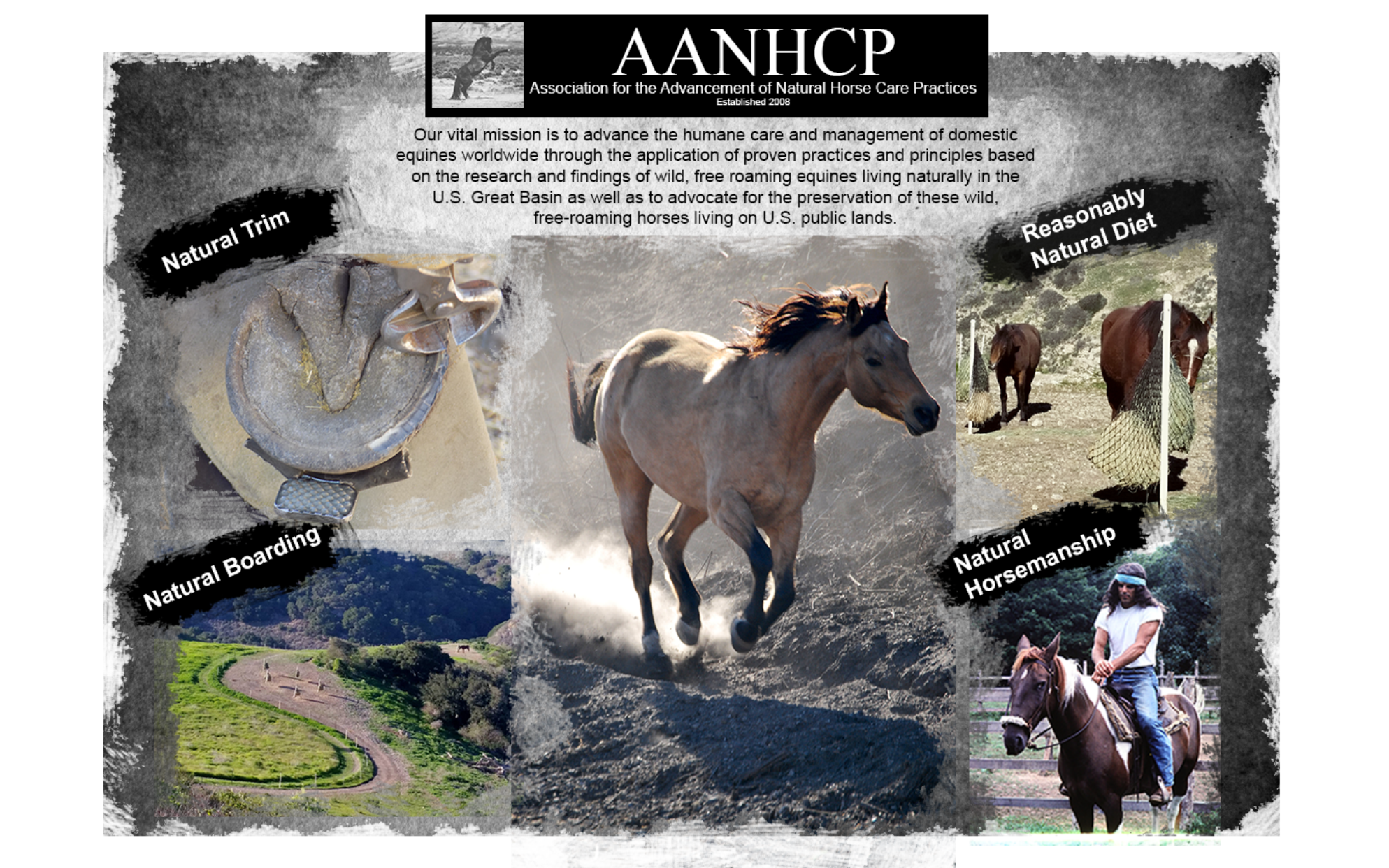
he vital mission of the AANHCP is to advance the humane care and management of domestic equines worldwide through the applications of proven practices and principles based on the research and findings of wild, free-roaming equines.
To learn more about becoming a natural hoof care / natural horse care practitioner, please see the NHC Training page at www.isnhcp.net.
All photographs of the wild horses above were taken by John Wheland in 2009 and 2010 in Oregon and Nevada. We extend our deepest gratitude to John for allowing us to share these images as they are not only great works of art but also incredibly educational. The tremendous health, soundness and happiness reflected in these images is no accident but is a result of their life in an optimal adaptive environment (see article below). The AANHCP continues to advocate for botanists, biologists, veterinary researchers and others to get out to the U.S. Great Basin to study these wild, free-roaming horses in order to bring their lessons to our domestic equines. The healthy hooves you see in these photos are simply the result of the horses living in an optimal state of biodynamic equilibrium. These horses are the picture of health and have not had to endure any meddling (chemical wormers, sweet feeds, stall life, shoeing, invasive trims, etc.) by well-intended but uninformed humans.
W
hy should horses be allowed to be barefoot?
Jaime Jackson: "The biology of Equus Caballus, the result of 60 million years of natural selection that culminated more than one million years ago, demands that we work with its nature — not against it. The equine species is genuinely adapted to go barefoot. It is only through human ignorance of the horse's natural state that led us to the incorrect, and harmful, conclusion that shoes are necessary -- or useful. They aren’t, and, moreover, contribute significantly to the lameness we see everywhere around the world."
Louise Bach-Holler: "The shoe was invented because poorly conceived boarding conditions made the horses sore-footed and the hooves deteriorate -- becoming brittle and weak. It is important to understand that most hoof problems that we see stems from bad boarding conditions (too much confinement, unnatural feeding, too little movement etc.) and not from genetic failure. Anything you nail or glue to the hoof will impede the hoof mechanism and thereby weaken the hooves and the horse's health in general."
Please click on ISNHCP (Institute for the Study of Natural Horse Care Practices) in the menu link at left to learn more about natural hoof care education and training.
News Briefs.......
Click HERE to go to the AANHCP Facebook page for the latest news, information and photos from the AANHCP and the ISNHCP.
<
P
eriodically we must remove Certified Practioners from our "Locate a Practitoner" listing if we have evidence that they are trimming below our standards and/or not to the guidelines. When this happens, the CP is contacted and also removed from the website listing - either temporarily - until they have taken action to improve their understand or their trimming and are able to demonstrate it - or permanently. If someone states on their personal website that they are Certified by the AANHCP and you do not seem them listed, you owe it to your horses to verify their credentials.
Please be careful about taking any advice on trimming from blogs! A lot of really bad advice is given each time we take a look at these blogs! Our best advice is to go to the Locate a Practitioner listing and use a certified Natural Hoof Care practitioner. Your horse will appreciate it.
O
n May 18, Jaime Jackson had the opportunity to tour the Houston Mounted Police Department's Mounted Patrol Unit facilities, the second largest in the U.S., where all 38 horses are now barefoot! Back in 2004, Sr. Police Officer Gregory Sokoloski first explored different barefoot trimming methods and was given approval to begin removing the shoes of some of the more seriously lame horses. Although they describe their initial methods as a bit 'too aggressive,' they found their way to natural hoof care by 2005 when Sr. Police Officers Scott Berry and Danny Pryor joined Officer Sokoloski at an AANHCP workshop conducted by former member Pete Ramey. The next year, Berry and Pryor enrolled in the AANHCP Natural Hoof Care Training Program and became Certified Practitioners in 2009.
Pictured from left are Sr. Officer Scott Berry, Jaime Jackson, AANHCP CP Eddie Drabek, Sr. Officer Gregory Sokoloski, Sr. Office Danny Pryor and Lt. Randall Wallace, who was ultimately responsible for allowing the officers to bring natural hoof care and natural horsekeeping practices to the Unit. A huge congratulations to all involved!
T
he Austin Police Mounted unit, first formed in 1984, began the process of 'going barefoot' in early 2007 after the unit supervisor, Sergeant Anthony French, attended a natural hoof care clinic held by members of the Houston Police Department's Mounted Patrol Unit (where all 38 horses are barefoot). While Sgt. French was in Houston, he met with officers of the Mounted Unit (which includes two AANHCP Natural Hoof Care Practitioners) and found that they ride in similar settings and terrain - about 60% of the time on pavement with the remainder in parks, hiking and biking trails and some areas that are very rocky and rough.
After getting the green light from 'upper managment' to go forward, Sgt. French found Joel Means (CP-Texas) through the AANHCP website and Joel pulled the shoes off the first horse on April 2nd, 2007.
"Overall, I would rate the program as a success from the start," said Sgt. French. "I don’t recall any major set backs in association with transitioning a horse to barefoot that resulted in lost working time for the horse."
One obvious advantage to the barefoot program was the cost savings associated with farrier bills, but this was not the driving force behind the transition.
"We wanted to be more natural and felt that this would benefit the horses overall to allow their feet to function as designed by nature," added Sgt. French. "We also saw an increase in confidence in footing on the pavement in both the horses and the riders. We have boots for each horse that are used as needed. We have several different models of boots from the Easycare line."
The Austin Police Mounted Patrol has an account with the Greater Austin Crime Commission for donations of both horses and monetary donations. The following is a link to provide for more details about donations.
lease go to www.isnhcp.net and click on the NHC Training link on menu.
We have moved the Natural Hoof Care Training Program to the "Institute for the Study of Natural Horse Care Practices" (ISNHCP). The AANHCP will continue to be the certifying body for students completing their training and education with the ISNHCP and, at this time, it is the only training program recognized for certification through the AANHCP. Students of the ISNHCP / AANHCP will continue to use only authorized AANHCP Field Instructors to conduct their mentorships for completing their NHC training.
AANHCP Membership is unaffected by this change. All AANHCP authorized CPs, TCLs, Field Instructors and other Clinicians will continue in the same manner as they have in the past with all students. Because the AANHCP will continue as the certifying body of the 'certification program,' all students in the ISNHCP NHC Training Program will continue to be required to be members in good standing with the AANHCP which includes paying annual dues, signing an Oath of Adherence and being subject to the Disciplinary Policy of the AANHCP should they be found in violation of that oath.
Finally, we have special pricing for Equine Veterinarians and graduates of Farrier Schools who would like to come into our NHC Training Program. Please contact Jill Willis (
This e-mail address is being protected from spambots, you need JavaScript enabled to view it
) to find out more.
From Shod to Barefoot, Hooves in Transition and other new articles...
C
lick HERE to see a few of Jaime Jackson's clients beginning with the day their shoes came off and then later after developing an entire new hoof capsule. Many people wonder if their horses can be barefoot and the answer is 'of course they can ALL be barefoot -- successfully, healthily and happily!'
It is the position of the AANHCP that ALL HORSES can be barefoot. Don't let anyone suggest otherwise.....
About the AANHCP....
T
he AANHCP is dedicated to promoting natural hoof care and natural horse keeping practices through our education and advocacy programs. A pioneer in the natural horse care revolution, the AANHCP continues to be the leading global force for the humane care of domestic equines worldwide.
Testimonials from the Clients of our Certified Practitioners
We frequently hear from horse owners about how they discovered Natural Hoof Care, an AANHCP Certified Practitoner and/or one of Jaime Jackson's books -- often after being told they had no other options except for a lifetime of problems, retirement or euthanasia. And so we decided to share some of these letters. (If you would like to send in a photo and written testimonial about your own horse who has been helped by an AANHCP Certified Practitioner, please email to
This e-mail address is being protected from spambots, you need JavaScript enabled to view it
)
"Y
ou'll be happy to know that my horses have surpassed all expectations barefooted. As you noted, I have posted some video and pics [on Facebook] of the terrain that I have ridden my horses through last weekend and they traversed with flying colors.
I really do not think that people fully push their horse's capabilities in that way and so probably do not really get to appreciate the full benefits of a barefoot horse, but the bottom line for me is that they would not have been able to do it shod as there was too much to slip on. Unknown among many equestrians is the amount of traction an unshod hoof will have on natural rocks. People notice it among mountain goats, but generally do not associate that with horses. But I have seen first hand this weekend the tremendous traction and increased stability of the unshod hoof.
I managed to traverse quite easily some extremely uncertain terrain, wet mud, sliding rocks, rolling river rocks, and a lot of shaky ground. The conditions were extremely treacherous and I would never have attempted it with a horse who could not fully feel the ground and have the traction it is supposed to have.
As a result I safely covered ten miles of National Wilderness on two horses with absolutely no ill effects, and not a single misstep. I credit a rigorous training regimen, solid conditioning, and unshod hooves.
If you would like to use this message as testimonial, please do not hesitate to do so.
Robin Shen, Ph.D,
Jan 3, 2011
Founder, Enlightened Horsemanship
Santa Maria, California
"I
n July of 2008, I made the decision to stop competing with my horse Stamp in barrel racing (pictured above this year) because he was sore. After my vet told me he had navicular I was devastated because he was only 4 years old at the time! I couldn’t accept this so I took him to PEI (the Veterinary College on Prince Edward Island) for a second opinion only to have them tell me the same thing. They told me that corrective shoeing and medication would probably allow me to continue to race for a couple of years and then maybe he would be a candidate for nerve blocking followed by an early retirement or he could be euthanized. This was not an option for me! I love my horse too much too see him suffer like that. That is when I started to research about natural hoof trimming. I called PEI to see what they thought about it and they told me to "stick to corrective shoeing." I didn’t listen!! I found (AANHCP CP) Gudrun Buchhofer’s brochure and called her immediately. She told me she would help Stamp.
"Against everyone’s advice, I went with the barefoot trim for Stamp. I decided to give it a try for a full year before I made any other decisions. I’m not going to lie; the first couple of months were really rough. He had some abscesses and he was extremely sore barefoot. So I used the hoof boots on him to get him through this stage. Sure enough, 4 months later I was back in the saddle. I wasn’t sure at this point if I could race him because everyone told me he could never run as well barefoot. Well, this summer we proved them wrong. Not only did he run just as hard as he did in previous years; he improved. This summer was the first summer I’ve had him that he was completely sound for the whole show season. He competed in almost every exhibition in the Dodge barrels and did great. I went from being the most skeptical person in the horse industry to the biggest fan of natural hoof care. Gudrun is amazing at what she does and she truly wants to help the animals. In my opinion, she saved my horse. It has been more than two years since he went barefoot and he continues to show improvements. And he has never had any more lameness issues. It not only improved his hooves but also his entire body."
Karen Hatcher & Going Postal (AKA Stamp), June 2010
(Client of AANHCP CP Gudrun Buchhofer - Novia Scotia, Canada)
The Natural Trim is a barefoot trimming method that uses the hooves of the wild , free-roaming horse living in the U.S. Great Basin as its model. By following the official AANHCP trimming guidelines, our certified practitioners (CPs) are able to mimic the natural wear patterns of these exemplary hooves. This gives us our template and foundation - along with diet and care - for genuine natural hoof care. The data used on the wild horse model is a result of the research and findings by Jaime Jackson in the 1980s in the U.S. Great Basin.
When adhered to properly, the AANHCP guidelines prevent invasive trimming practices as well as methods that leave excessive growth which have a deleterious impact on the hoof's integrity and soundness. Contrary to the misguided opinions of either its detractors, the wild horse model does not imply or yield a "cookie cutter" approach to trimming but instead facilitates the unique individual healthy growth patterns of each horse without causing harm or obstructing the natural gaits.
Please Consider Making a Donation to Help!
T
hank you for considering a donation to support the AANHCP's vital mission. Your generous donation will be credited towards supporting our domestic and wild horse advocacy, research, and public education.
You may donate in a number of ways! Send any amount to the AANHCP using PayPal using the email address "
This e-mail address is being protected from spambots, you need JavaScript enabled to view it
This e-mail address is being protected from spambots, you need JavaScript enabled to view it " as the recipient. Or, click on "Payments to the AANHCP" on menu at left and make a payment using your Visa or Mastercard. Or please send check, payable to the AANHCP, to the AANHCP at P.O. Box 1432 Lompoc, CA 93438.
Please consider us in your estate-planning! Contact Jill at
This e-mail address is being protected from spambots, you need JavaScript enabled to view it
This e-mail address is being protected from spambots, you need JavaScript enabled to view it if you wish to discuss arrangments on bequeathing funds to the AANHCP or making financial and natural care arrangements for your horse(s) upon your passing. Or simply request that your funds go to help those horses we know of who are in need of healing, rehabilitation, rescue, and/or permanent natural care.
If you would be willing to make land available to the AANHCP to use as a model for natural horsekeeping practices, we are in the process of developing non-profit natural boarding and rehabilitation facilities across the country in order to demonstrate how a proper diet, movement and living among other horses are essential components to a healthy and happy horse. Land could be donated and signed over to the AANHCP or simply 'designated' on a long-term, no-cost lease.
The AANHCP is a 501c3 non-profit organization. Please confirm with your tax consultant regarding IRS deduction benefits.